How I turned WhatsApp chaos into an operational command center
Workforce management platform for Nigerian SMEs that prioritizes trust (real-time earnings visibility) before efficiency (automation).
RoleTeam Lead & PM
Timeline3 Weeks
TeamTEAM 10 (Cross-Functional PMs)
StageLive Prototype
The Problem
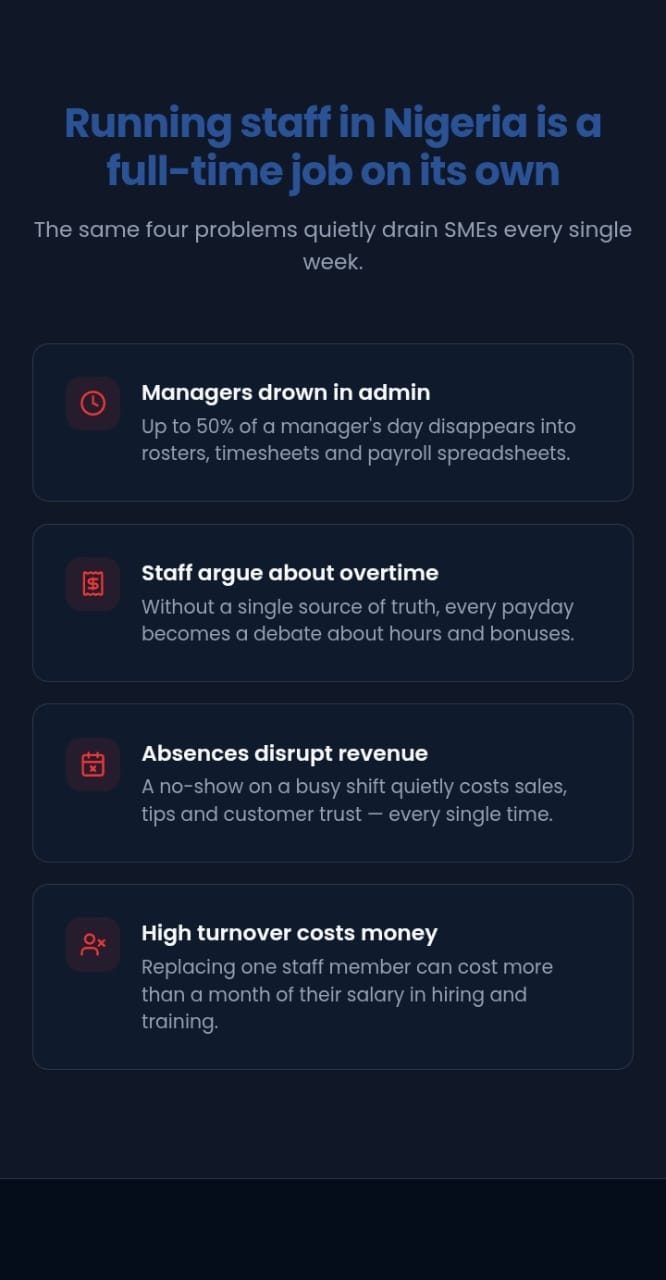
Running Staff in Nigeria Is Full-Time Work
We interviewed 50 people spanning across business owners, managers, supervisors, and frontline staff. The pattern was consistent: Managers spend 3+ hours every week chasing shift coverage on WhatsApp. When someone calls in sick, they ask other staff to cover. When nobody comes, the workload concentrates on those on duty, reducing productivity significantly.
Restaurant owner in Lagos has 12 staff. Every week:
2.8 hours chasing shift coverage on WhatsApp
Zero visibility into who worked when
Payday disputes: "I worked 2 extra hours" vs. "No you didn't"
Staff: 64.7% never paid for overtime
Owner: No single source of truth, no way to prove what happened
The Administrative Drain
2.8h
Wasted per manager per week on scheduling
134 hours/year per business
The Trust Gap
64.7%
of staff never paid for overtime
Chronic payday disputes
The Overtime Burden
82.4%
of staff work unpaid OT monthly
No earning transparency, no accountability
The Simplicity Requirement
36.4%
require exceptional ease-of-use
Complexity = non-adoption
The core problem: Visibility breakdown. Without data, trust erodes. Without trust, operational chaos persists.
My Role
Team Lead & Product Manager
During the TSAcademy capstone, I led a cross-functional team of 10 PMs. My responsibilities: end-to-end product vision, user research design and execution, feature prioritization, pricing hypothesis, cross-functional negotiation, and MVP delivery in 3 weeks.
This section showcases the decisions I made—and what I learned navigating tradeoffs.
Strategy
The Approach
Instead of building every feature in the world, I asked: What's the minimum viable thing that addresses the core pain?
Two insights shaped everything:
01Managers care more about visibility than automation
02Staff are highly motivated by seeing their earnings in real-time
So the strategy became: Real-time earnings visibility + frictionless shift claiming + automatic tracking. Not 'automate everything.' Just remove the friction and build trust.
Strategic Pillars
01Earnings Visibility — Staff see exactly what they earned, daily
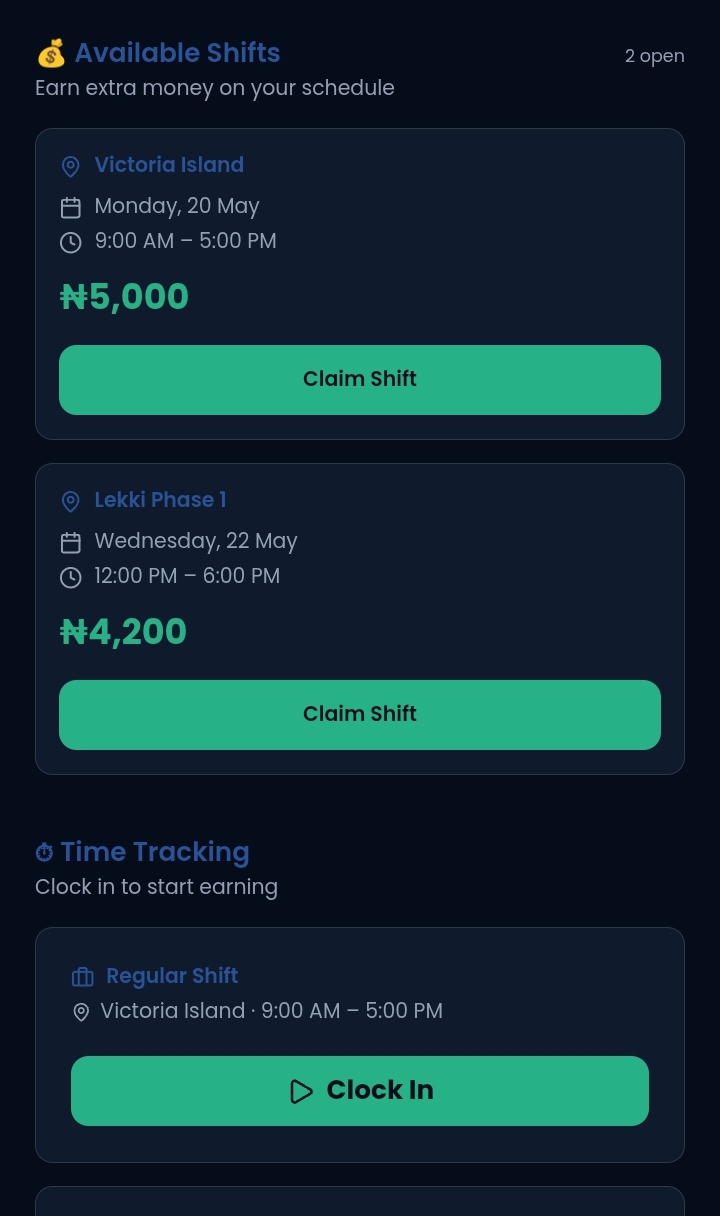
02Shift Claiming — One tap to claim a shift (not 30 minutes of WhatsApp)
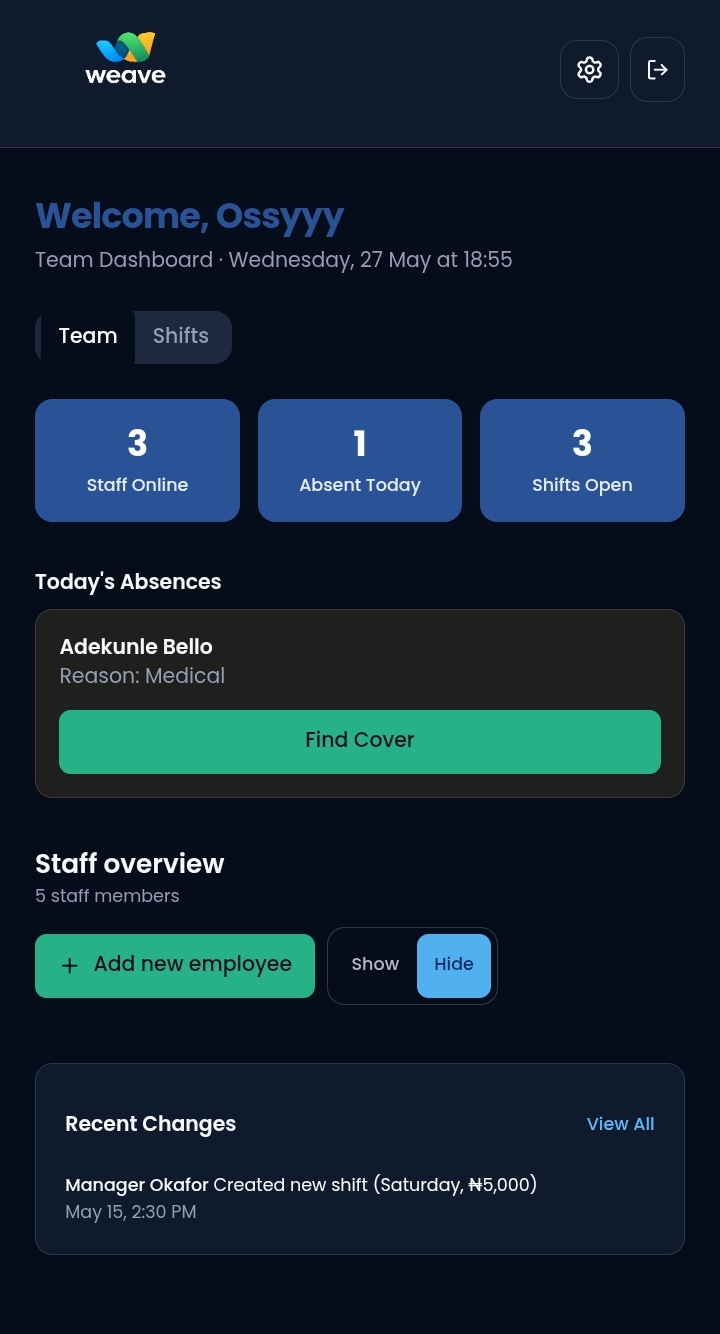
When staff are absent, don't make it a problem to solve alone. Post the shift. Let other staff claim it for extra income. Problem solved in 30 seconds instead of 30 WhatsApp calls.
Why It Matters
This reframes absence from 'chaos' to 'opportunity.' Staff get extra income. Managers find cover instantly. Network effects kick in as more staff join.
The Trade-off
✗ Requires critical mass (doesn't work with 2 staff)
✓ Solves the core pain (10+ hours/week on calls)
02
Offline-First
The Idea
App works without internet. Staff clock in/out offline. Data syncs when connection returns.
Why It Matters
Nigeria's networks are unreliable. WiFi cuts out. 3G drops at inconvenient times. If staff can't clock in because there's no signal, the product fails. So I built for offline.
The Trade-off
✗ More complex architecture
✓ Actually works in Nigeria (this is competitive advantage)
03
Earnings Shown Monthly
The Idea
Display earnings as monthly totals ('₦45,600 this month so far'), NOT daily ('earned ₦800 today').
Why It Matters
Daily ₦800 feels demotivating. Monthly ₦45,600 shows real value. And it matches how SMEs pay (monthly salary cycles). I learned this from interviews. One manager said: 'If I saw ₦800, I'd feel like I earned nothing. But ₦45,600? That's real money.'
The Trade-off
✗ Staff can't see daily earnings
✓ Better psychological impact (they stay engaged)
04
One-Time Invite Codes
The Idea
Each employee gets a unique, one-time-use code (expires in 30 days, can't be reused).
Why It Matters
Secure (can't be exploited). Scalable (no shared company code bottleneck). Auditable (tracks who used what code).
The Trade-off
✗ Manager must generate per employee
✓ Scales to hundreds of staff, stays secure
05
Transparent Earnings Formula
The Idea
Show the math: Salary - Deductions + Overtime = Total
Why It Matters
Staff don't trust 'math on paper.' When they see the formula and can verify it, trust builds. Month-end disputes disappear.
The Trade-off
✗ Requires accurate calculations (no room for error)
✓ Eliminates the biggest point of friction (salary disputes)
Strategic Tradeoff
Visibility First. Automation Later.
01Early roadmap included: automated payment gateways, salary advance features, contractor marketplace. All "nice to have." But research showed: 100% of interviewed owners use manual spreadsheets + WhatsApp transfers. Zero use payment gateways. And 88% said "The payroll part is fine—I just need to see what happened."
02The temptation: Build the sexy thing (automated payments). The reality: Build what they actually need (earnings visibility + CSV export for their existing workflow).
03Stakeholder negotiation: Engineering wanted to build payment API integrations (resume-building). I pushed back with data and a 3-beta-user validation plan. When we showed it to beta users, they said the same thing: "This is all we need." Engineering agreed. We cut scope by 40%.
Shipped in MVP
Real-time earnings ticker (staff see accrued OT in real-time)
One-tap shift claim (30-second flow validated with users)
Automatic OT tagging (system marks 8+ hour shifts)
Cut, not because they're bad ideas, but because they solve problems users don't have yet. v1 validates the core hypothesis (visibility → trust). v2 scales to automation once trust is proven.
Tools: Lovable.ai + React (no-code accelerator). This speed forced ruthlessness on scope. Every feature had to justify its existence in 15 minutes of user feedback, not 2 hours of spec debate.
Onboarding completion rate: 100% (3 beta users)
Shift claim time: 28 seconds (target was <60s)
Earnings visibility delight: 3/3 beta users reopened prototype to show staff
Kill criterion: <30% W4 retention after 4 weeks (TBD post-beta)
Owners care more about visibility (trust) than automation (efficiency). The ticker—not the scheduler—was the feature they reopened the prototype to show staff. This validated the hypothesis before production.
If I built this again: I'd extend the beta to 10-15 businesses before finalizing the earnings display format. Small UX changes here compound on adoption.
Metrics & Hypotheses
What "Working" Looks Like
Adoption
Weekly Active Businesses
Target: 100 by month 3
Signal: Product-market fit exists
Engagement
Shift Claim Time
Target: <60 seconds (validated)
Signal: UX is frictionless
Retention
30-Day Retention by SME Size
Target: >40% (small SMEs 5-10 staff)
Signal: Product holds value beyond novelty
User Validation
Manager Feedback
“
I don't have time to learn new tech. But this... I just opened it and posted a shift. A staff member claimed it in 30 seconds. I've never seen anything work that fast. If this costs ₦10,000, I'm paying it.
— Chioma, 34 | Restaurant Owner, Lagos
“
The shift thing is nice, but honestly? I use this to check what my staff earned before they ask me. No more arguments about who worked what. They know the number before they talk to me.
— Tunde, 41 | Supermarket Manager, Ibadan
“
I have 8 staff and I was spending my mornings on WhatsApp. Now I post, they claim, done. Gives me back 2 hours every day. That's real money back.
— Fatima, 38 | Salon Owner, Abuja
Frontline Staff Feedback
“
Before this, I never knew if my manager was paying me right. Now I see the number every day. ₦45,600 this month. I can plan. I can trust. That changes everything.
— Chiwendu, 26 | Restaurant Server, Lagos
“
The shift marketplace is genius. I was broke, I saw a Saturday shift posted, I claimed it. Extra ₦6,500. If there are more shifts, I'll keep using this.
— Zainab, 23 | Retail Staff, Kaduna
“
My manager used to write down my hours on paper. I never knew if it was right. Now it's automatic. Clock in, clock out, done. And I can see exactly what I earned. No stress.
Earnings visibility drives adoption. The ticker, not the scheduler, was the feature users showed to staff.
Validation
Results and Impact
Key Validation
From testing with 3 managers and their teams:
All 3 managers successfully posted shifts and found cover (within target time)
All staff accurately tracked their hours using the app
All staff confirmed earnings transparency reduced trust concerns
Mobile-first design worked smoothly (100% of interactions on-phone)
What We Learned
The earnings visibility feature is what managers and staff care about most. Not the scheduler. Not the fancy features. The ability to see exactly what's owed and when. That single feature builds the trust layer that makes everything else stick.
Reflection
Reflections and Next Steps
What I Learned
Leadership is about creating clarity so others can contribute their best thinking. Data shapes decisions better than assumptions (interview findings drove every call). Building reveals what matters faster than planning (execution > theory).
What's Next
Phase 2: Backend infrastructure for multi-tenancy and real employer management
Phase 2: Refine based on extended testing feedback
Phase 3: Deploy with real employers and measure sustained usage
Focus: Perfect the core experience before adding features.
Why This Matters
This project proved something fundamental to me: good products come from listening, not from assumptions.
I could have built payroll automation, biometric auth, and advanced analytics. Instead, I asked 50 people what actually hurts. I designed a solution. I watched how they interacted with it. And I learned what actually matters.
That's the methodology I'd bring to any PM role: Research → Design → Build → Learn → Iterate.
Not theory. Not guessing. Just asking, building, and paying attention to what actually works.